
The arrival of the spring sun last week felt like a genuine new beginning, the kind that naturally gets you looking back while sizing up the present. For me, that warmth triggered a flood of memories from a very different climate—specifically, the blistering, unbearable heat of the Persian Gulf during the Armilla patrols of late 1994 to May 1997.
The name "Armilla" comes from the Latin word for a bracelet or armlet, symbolising the protective ring the Royal Navy placed around the vital trade routes of the Middle East. Back then, my world revolved around maintaining that ring as the Senior Maintenance Rating and Charge Chief Petty Officer (CCPO) on board HMS Chatham, our Type 22 stretched frigate.
Looking at the Royal Navy’s force projection today, it is impossible not to view modern operations through the lens of those gritty, oily, and exhausting deployments.
The Pocket Destroyer and the Sea King "Truck"
Days on board Chatham were long, arduous, and punctuated by six-month stints where the machinery constantly buckled under sea temperatures exceeding 30°C. We lived in a relentless cycle of fire-fighting, damage control, and gunnery exercises. Yet, what made Chatham a legend among her peers—often earning her the title of "Pocket Destroyer"—was our organic aviation punch: 826 'A' Flight, there was of course a sister ship HMS Cumberland and 826 'B' Flight' who we swapped operations with but I spent almost three years on the Chatham becoming the SMR pronounced "SMUR" effectively I was the Air Engineering Officer of a small squadron and what an experience it was.
While most frigates of our era carried the agile Lynx—the "sprinter"—we packed a massive Sea King HAS.6 helicopter into the hangar space. They were a ship's "truck" and the ultimate Swiss Army Knife of the ship.
In the mid-90s, regional navies mostly operated small patrol boats. Seeing a frigate capable of launching a large, sonar-dipping Sea King was a massive statement of British anti-submarine capability. Our presence was proved definitively during one memorable tactical exercise, where Chatham successfully "sank" the aircraft carrier HMS Invincible—simply because their command team was entirely unaware we had the sensor range and endurance of those Sea Kings tucked up our sleeve.
When a merchant ship became stubborn during high-readiness boarding operations, we didn't shuttle Royal Marines from 40 or 42 Commando in small groups. 'A' Flight would lift ships company trained sailors in one go, using rapid-roping to seize control of suspicious vessels in a matter of minutes.
Fighting the Elements and the "Orange Moth"
Managing that ten-ton beast was a relentless, around-the-clock battle against physics and geography. Transitioning from the cold damp of HMS Gannet in Prestwick, Scotland, to our new home at RNAS Culdrose, and then straight out to the salt-saturated humidity of the Adriatic (during Operation Sharp Guard) and the Persian Gulf meant my team faced an uphill battle. The "Paint and Fabric" and Airframe ratings were constantly fighting a losing war against the "orange moth"—rust.
The Persian Gulf environment actively tried to destroy the aircraft. The salt and sand would literally "cook" onto the Rolls-Royce Gnome engines. To prevent them from losing catastrophic power in the thin, hot air, my flight crew developed an almost obsessive routine, carrying out compressor washes and filter changes three or four times a day. Doing engine swaps or complex gearbox repairs in the heavy humidity of a Gulf summer was punishing work, often requiring us to seek a stable flight deck via a detachment to Bahrain or port time in Dubai.
As the CCPO, I was the orchestrator of the hangar "dance." Fitting a Sea King into a Type 22 hangar required folding the tail pylon and main rotor blades and this was not easy on a pitching deck. I remember one event when the weather was extremely rough, severe pitching in a rolling sea state, this was a high-stakes choreography managed entirely by eye, instinct, and raw seamanship. Keeping the serviceability stats high for the Skipper while attending every daily briefing meant bridging the gap between the Flight Commander’s tactical demands and the brutal reality of what my maintainers could actually achieve on a moving deck.
This one time when the mechanical handler lifted up the tail wheel and we commenced a move with two men walking alongside the main wheels ready to chock and lash the landing gear down, if the 'beast' decided to slide. When she did, that late evening after the final landing the whole aircraft became a problem.
The man on the brakes in the cockpit looked terrified as I made a decision to stop the move and apply storm lashings and chains. The aircraft had almost sideways to the port and starboard railings of the flight deck .
Communications was being shouted down from the bridge "get the aircraft into the hangar SMUR" came the order. I took another look and picked up the phone "Sir, its unsafe, we need to get out of the storm and revisit the move when we have a steady course" - the reply came back "SMR, get the aircraft into the hangar".
I saw my life ahead of me as a demoted Charge Chief, probably busted down to Leading Hand and envisaged the embarrassment of losing the aircraft over board with my whole career gone.
So, I stuck to my guns and said" Sir, I'll move this aircraft on the understanding your take full responsibility if something, I have advised you of, goes wrong" - there was a pause for about two minutes then came the reply "Okay, SMUR, lash the aircraft down. "
From the Cold of the Black Sea to an Island Oasis
Our journey wasn’t just spent in the sweltering Gulf Box; it was a massive global odyssey that began with high-profile diplomacy. Following the collapse of the Soviet Union, we undertook a historic "showing the flag" tour into the Black Sea and Baltic, visiting Odessa, Constanta, Helsinki, and St. Petersburg. For my maintainers, these visits meant endless "Open Ship" days where thousands of locals queued up just to marvel at our massive Sea Kings.
From the freezing northern waters, we turned south, transiting the Suez Canal to begin our first gruelling back-to-back Armilla Patrol. The tempo was relentless, but the Navy knew how to reward a hard-working crew.
During our transit out to the Far East, we stopped in the Maldives, where the ship was "given an atoll for the day" for a traditional beach Banyan. The highlight of the day was entirely orchestrated by 'A' Flight initiative: one of our crew members, a champion windsurfer, used his board as a cargo vessel, brilliantly ferrying crates of cold beer across the surf directly to the waiting, sun baked lads on the beach.
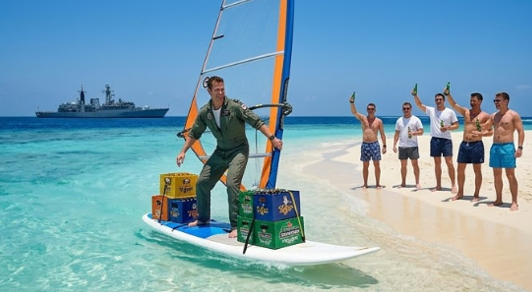
That brief oasis was followed by a magnificent standoff period in Southeast Asia. The command arranged for our wives and partners to fly out and join us—giving us one unforgettable week of luxury at the Rasa Sentosa resort in Singapore, followed by another week in Phuket, Thailand. While the families enjoyed the five-star treatment, the rest of the crew experienced a classic, legendary 90s run ashore in Phuket. It was the ultimate high point of morale, but the true test of 'A' Flight was looming just over the horizon.
Stripped for War: The Congo Standoff
The true whiplash of naval life hit us when Chatham was suddenly diverted to the coast of West Africa. Zaire (now the Democratic Republic of Congo) was collapsing into a brutal coup under the Mobutu regime, and we were ordered to stand by for a Non-combatant Evacuation Operation (NEO) to rescue stranded British nationals.
The plan was audacious: Chatham was intended to sail down the confined waters of the Congo River, launch our aircraft, and establish a Forward Operating Base (FOB) deep inland. Every daily briefing read out tense signal traffic that carried a sobering warning: "Remember the Amethyst"—a stark reminder of the 1949 Yangtze Incident where an RN frigate was trapped and fired upon up-river.
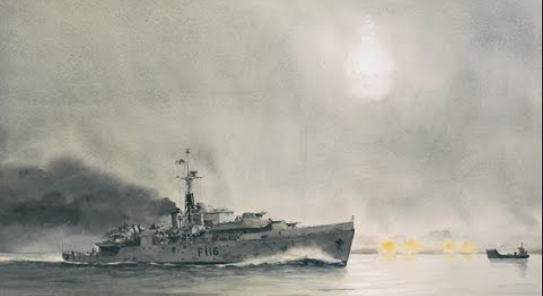
The atmosphere shifted instantly. We went from tropical beach BBQs to being issued Kevlar body armour, downing malaria tablets, and conducting live-firing practice off the back of the ship.
For 'A' Flight, the mission required an extraordinary, overnight transformation. Our Sea Kings were sophisticated anti-submarine platforms, but to fly troops inland, we had to shed weight. In the tight confines of the hangar, my team stripped out the heavy Type 2069 sonar winches and internal consoles, converting the "Pinger" into a troop-carrying "Jungly."
The aircrew seemed far more excited about this sudden shift to a combat footing than the "chosen men" who had to make it happen. I couldn't take the whole detachment inland, so I had to hand-pick my most experienced, battlefield-ready maintainers—the lads who had "oily bits" under their fingernails and didn't need a technical manual to keep an aircraft turning in the mud. To give our boys some teeth, we even engineered a temporary modification, fabricating a custom mount to fix a GPMG (General Purpose Machine Gun) directly over the main Sea King's upper entrance door so we could fire from the front and the out the cargo door where the proper fitted gun was also operated.
For ten tense days, we sat at high readiness off the coast, training and waiting. Ultimately, the neighbouring Republic of the Congo refused us permission to fuel from their port at Pointe-Noire, and diplomatic shifts allowed us to stand down. But for those ten days, 'A' Flight proved we could weaponize a frigate's flight deck on the fly. Needless, to say the operation was carried out to get the ex-pats to safety when the Royal Marines took our place using dirigibles to set up a forward operating base and we were sent on our merry way to continue on with our intended course and my final trip on the 'Pocket Destroyer'.
"Get That Off My Deck!": Mandela’s Jubilee and Durban
With the African crisis averted, we sailed south to a historic post-apartheid South Africa to celebrate Nelson Mandela’s Jubilee. It was the height of "Madiba Magic." We put into Simon's Town and Cape Town, where our crew was granted the immense honour of marching our Field Gun, which we had brought with us and marched in our "ice cream suits" through the packed, cheering city streets.
From there, we sailed into Durban, a visit cemented in Chatham lore by a classic bit of naval sky-larking. As we prepared for Procedure Alpha—entering harbour with the entire ship’s company lined up on deck in their immaculate tropical whites—some of the lads smuggled a life-size cardboard cut-out of Hansie Cronje, (who then was the idolised captain of the South African cricket team), onto the flight deck.
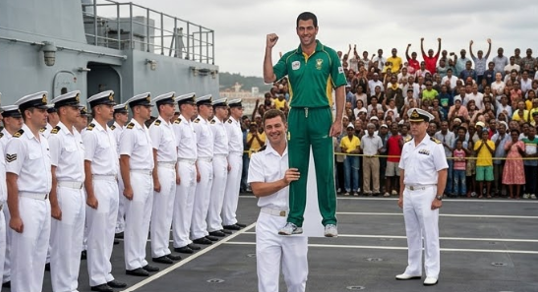
As we drew alongside the crowded jetty, the welcoming crowd spotted the cutout and erupted into an absolute frenzy, chanting "Hansie! Hansie! Hansie!"
The absolute uproar of the crowd was instantly punctuated by the furious roar of our First Lieutenant echoing across the flight deck: "Get that bloody thing off my deck SMUR!" The thing had been placed next to me and so needless to say, Hansie was swiftly tackled and retreated to the safety of the Chiefs’ Mess to join us for a celebratory beer later.
While the crew's sky-larking in 1997 was a stroke of public relations genius that sent the Durban crowd into a frenzy, history would soon paint this moment in a far more cynical light. The life-size cutout of the idolised captain, paraded during the rigid formality of Procedure Alpha, stood as an unwitting monument to a massive deception. Just twenty-four months later, the hero of Durban would be exposed as a match-fixer, transforming this lighthearted piece of Chatham lore into a stark reminder of how quickly sporting icons can fall from grace.
The Final Handover
After the triumphs of South Africa, we turned north to complete our second back-to-back Gulf patrol. My time was finally served, and I handed over the flight to my relief, flying back to the UK out of Dubai.
Modern aviation platforms like the Merlin Mk2 are marvels of digital engineering, and the highly automated Type 23s and Type 45s offer incredible technological advantages. Today's boarding teams operate with surgical precision, backed by real-time satellite data and drone telemetry.
Yet, in this highly networked, transparent battlespace, I wonder if we’ve traded away a bit of our flexibility. The high flying rates we maintained during those years meant that if the Sea Kings were down, the ship's primary capability was halved. The pressure on me to "produce the aircraft" for a 3:00 AM boarding call was immense, but we delivered because of that "fix it in any weather" mentality.
Spring may bring clean slates, and the modern Navy may have sleeker lines, cleaner engines, and digital screens—but they will never quite match the raw, oily magic of a flight deck crew dancing in a gale to launch a ten-ton beast into the Gulf night.
POEM
Grandad's Odyssey
"What kind of life did you have, Grandad, can you tell me please?
When you joined with the sailors on the oceans and seas."
"There was pitching and rolling, but also banyans, my grandson,
And we had to keep cool under the Armilla’s sun.
For it was during those times, when we were 'up ’em and at ’em';
Such were those mighty episodes on HMS Chatham."
"Was it worth it though, Grandad, those twenty-eight years?"
"I guess it’s a yes, through the blood, sweat, and tears.
Visiting Odessa when it was part of Ukraine,
And hauling my aircraft through the gales and the rain.
For it was during those times, when we were 'up ’em and at ’em';
Such were those mighty episodes on HMS Chatham."
"Would you do it all over, if you had the chance?"
"In a heartbeat, my boy, I’d rejoin that deck dance.
With the GPMGs mounted and the sonar stripped bare,
And the raw, oily magic of the Gulf evening air.
For we lived in the times when we were 'up ’em and at ’em';
And my proudest days sailed with the crew of the Chatham."