Every day, our phones screen out the noise of the world. We ignore the "No Caller ID" pop-ups, glance past the "Suspected Scam" warnings, and let strangers go straight to voicemail without a second thought. We rely on our screens to tell us who is safe. When a familiar name lights up the display—someone saved in our contacts, linked to an address book built over decades—the guard comes down instantly. We answer without hesitating, assuming that the identity on the screen guarantees the person behind it. But in the quiet suburbs of Ottawa's west end, where the October frost locks down the crescents, that trust is tested against a quiet, lethal reality.
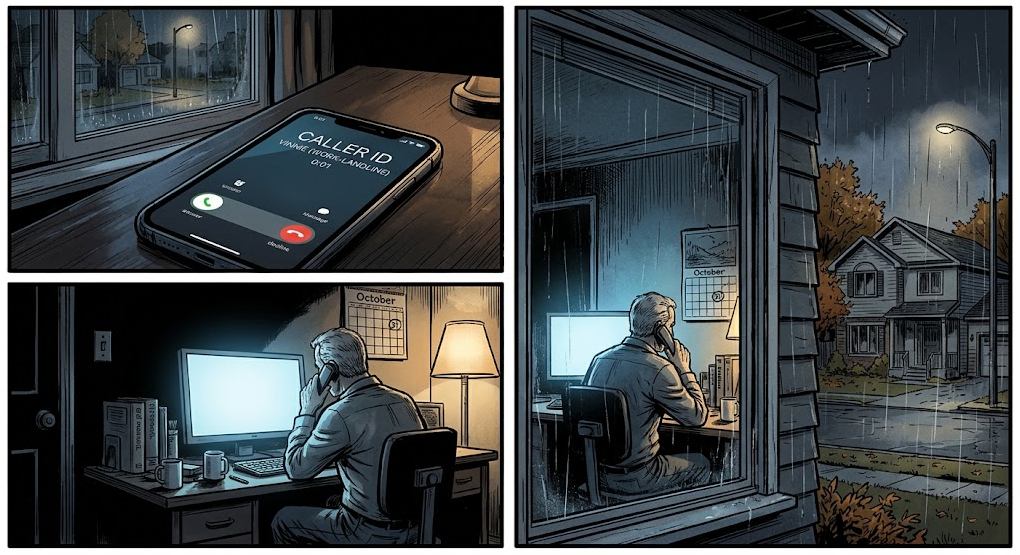
The phone always rang precisely at seven on Tuesday evenings and Thursday nights, cutting through the heavy, suffocating silence of Vinnie’s drafty Kanata home.
At sixty-seven, Vinnie was learning that retirement wasn't a reward; it was a slow attrition. He spent his nights hunched over a desk in the corner of his living room, grinding away at data-entry contracts. The only steady bridge to the outside world was Stevie. Stevie was wealth and success, a former executive from their shared days at the old Nortel campus off March Road. Yet, Stevie called faithfully, twice a week.
Lately, however, those conversations had begun to curdle with a creeping dread. It started a month ago, when Stevie casually mentioned that Dave—their old manager—had been found dead in his Barrhaven home. The doors were bolted, the police called it natural, but the receiver had been left dangling off the hook. Then last week, Sarah from accounting. Same thing. Stittsville.
Tonight, the line crackled as Stevie spoke. "By the way, Vinnie, did you hear about Marcus?"
Vinnie paused, his hand tightening around the receiver. "Marcus? From product development?"
"Yeah," Stevie said, a heavy sigh crackling through the phone line. "They found him this morning over in Kanata Lakes. Same as Dave and Sarah. Heart just stopped. Crazy how many of the old March Road crew are checking out lately, isn't it?"
Vinnie looked around his dark, silent room. The freezing rain streaked down outside, reflecting the dull amber glow of the streetlamp across the crescent. He was the last one left from that old floor plan.
"Well, I didn't mean to depress you, old man," Stevie said, his cheerful tenor returning. "Just checking in on you. Make sure you're keeping your doors locked tight tonight, alright?"
"Always do, Stevie," Vinnie replied softly.
"Good man. I'll ring you Thursday."
The line clicked dead. In the absolute quiet of the house, Vinnie sat slumped motionless in his chair, his body cold and entirely devoid of breath, while his front door hung unlocked from the inside.
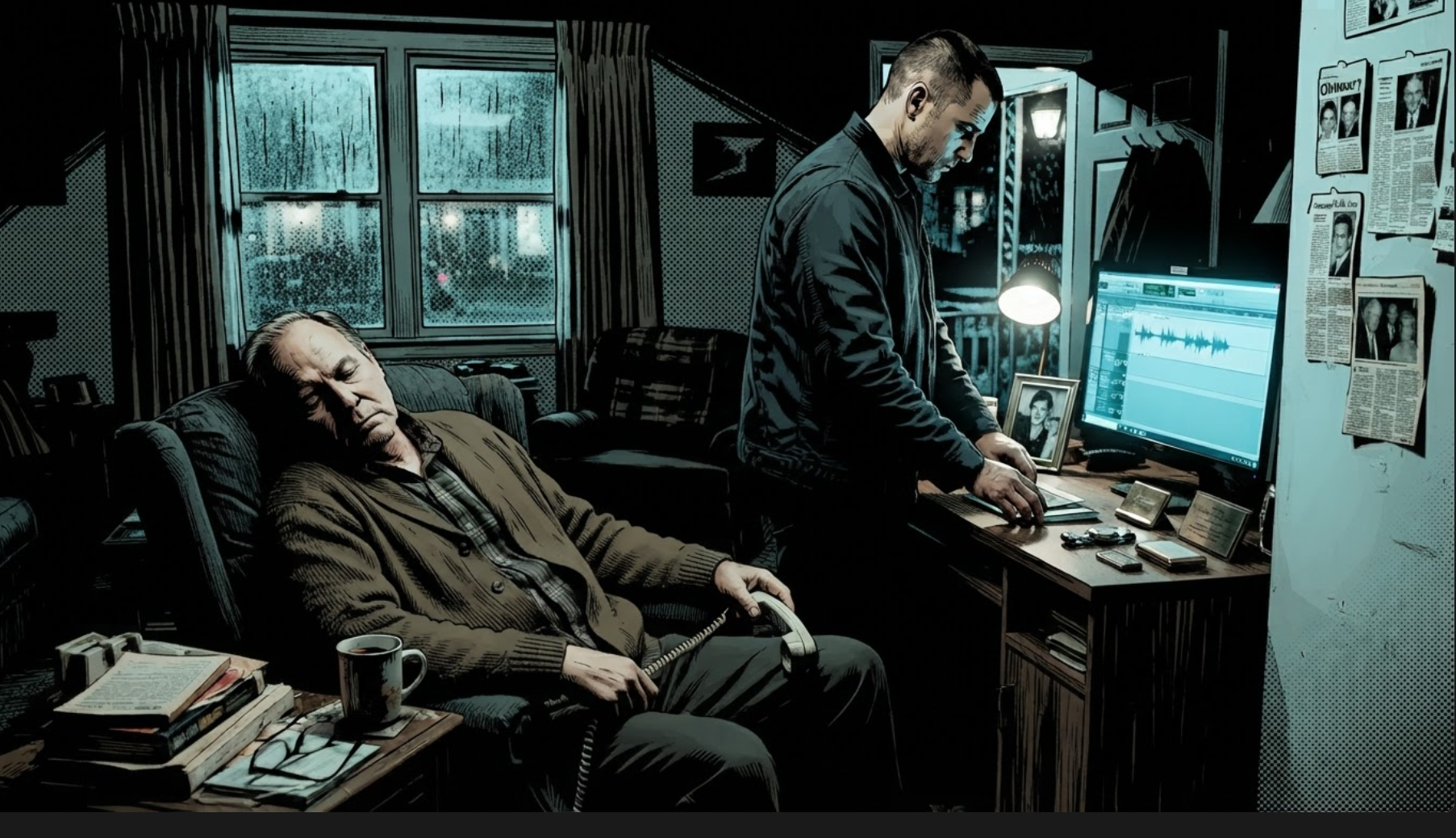
Stepping quietly out from the deep shadows of the room, the intruder walked over to the desk. He looked from Vinnie’s lifeless form in the armchair to the wall covered in obituaries, newspaper clippings, and printed police blotters pinned beside the desk. Vinnie hadn't just been grieving their dead colleagues; he had been obsessively tracking them. He was the only one who had pieced together the trail from Barrhaven to Stittsville, capturing audio waveforms on his monitor to prove the caller IDs were spoofed. He had been days away from exposing the truth.
The killer pulled a duplicate of Vinnie’s old Nortel employee ID badge from his pocket, dropping it into a velvet-lined case alongside key cards belonging to Dave and Sarah. On the workstation monitor, the audio waveform flickered green as Vinnie_Landline_Final.wav finished rendering. He clicked save, pocketed his drive, and stepped back into the night.
When Thursday evening arrived, Stevie sat in his Audi parked under the dark underpass near March Road, two blocks down from Vinnie’s crescent. The freezing rain beat a relentless rhythm against the glass.
Something had bugged Stevie about Tuesday's call. Vinnie’s voice had sounded slightly flat, missing the tiny, involuntary throat-clear he’d had for thirty years. Driven by a nagging instinct, Stevie hadn't waited for seven o'clock. He had driven to Kanata on Wednesday, only to find the crescent cordoned off with yellow tape. Ottawa Police patrol cars sat in the driveway—Vinnie had been found cold in his armchair, receiver hanging by its cordline. Preliminary report: sudden cardiac arrest. Another natural death.
It was later that afternoon, after the coroner left, that Stevie used his spare key to step inside. The police had treated it as an unattended natural death of an elderly man. But in Vinnie's office, Stevie found the board pinned to the wall: clippings linking Dave in Barrhaven, Sarah in Stittsville, and Marcus in Kanata Lakes. Tucked behind the clippings was a leaked technical analysis Vinnie had pulled from a cyber-forensics contact:
“Traces of synthesized SIP-packet spoofing detected at local routing node 04-B. Caller ID originates from internal PBX trunk routing—a legacy Nortel protocol discontinued in 2009.”
Pinned right beside the note was a small index card, in Vinnie's hobby box of poetry and blogs covered in Vinnie's neat, trembling handwriting—a desperate warning left for the only friend he had left, it read to Stevie....
Most people are good, though a few you can't trust,
In distant days gone, when work turned to dust.
The calls that you wait for relieve life’s dull chore,
When memories of purpose now cut to the core.
Some people are never quite who they appear,
Just a name in a contact list, masking your fear.
Take care who you answer to, or who you answer for—
Lest you add your own name to Marcus’s score.
Vinnie had written three words in thick red marker next to the Poem : MARCUS IS ALIVE.
Marcus wasn't dead. He had faked his own passing to clear his name, using his mastery of legacy telecom networks to masquerade as the dead, hunting down his old team one by one to settle an unsaid, ancient grudge from the collapse.
Stevie looked down at his smartphone on the passenger seat. The clock flicked to 6:59 PM.
At exactly 7:00 PM, the Audi's centre console display flashed:
INCOMING CALL
Vinnie (Home)
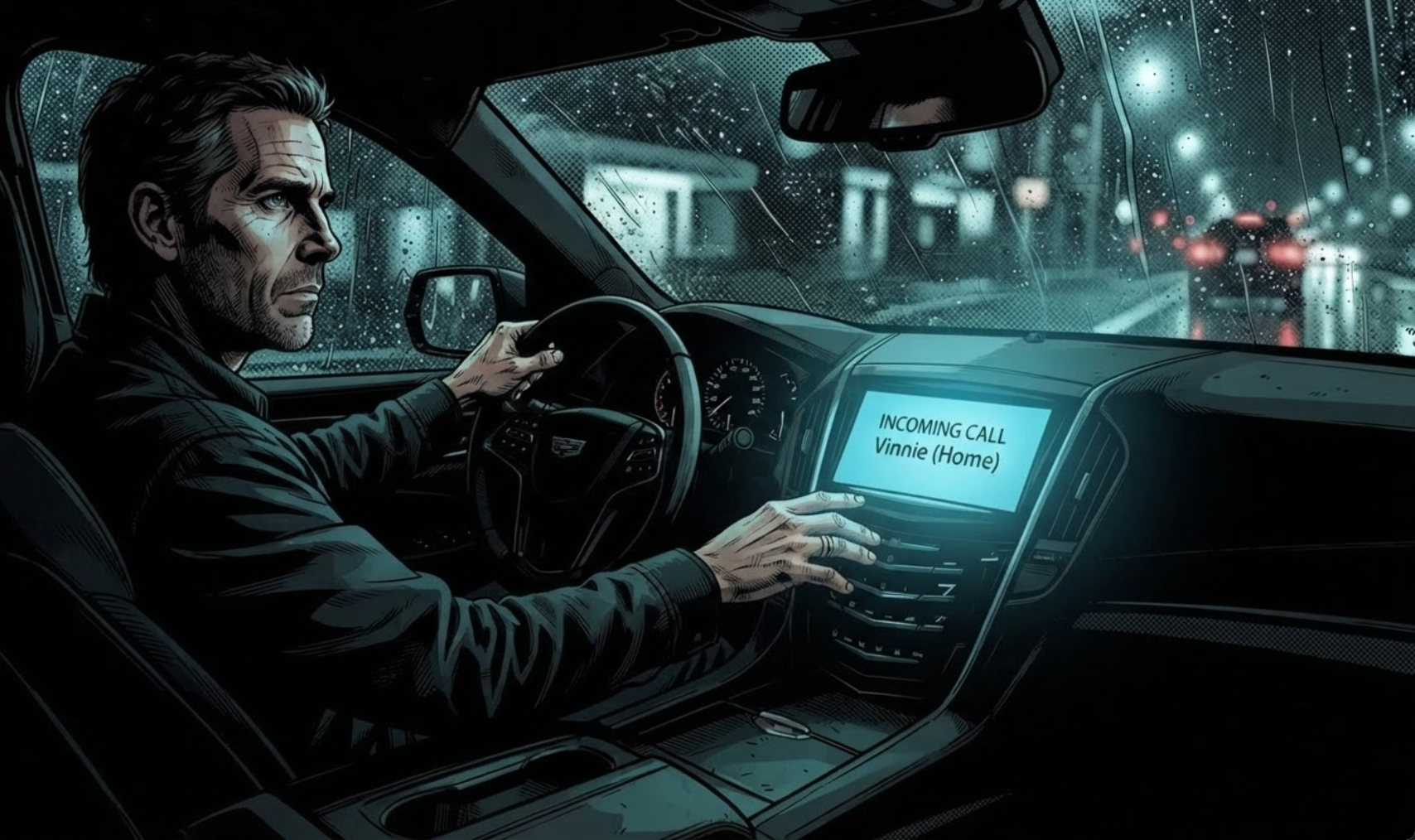
Stevie took a deep breath, flipped on his dashboard recording rig, and swiped to answer, placing it on speaker.
"Hey, Stevie," Vinnie’s voice came through the speaker—warm, familiar, and utterly convincing. "Sorry to call a minute early. Just wanted to make sure we were still on for our chat."
Stevie felt the cold chill run down his spine. It was Vinnie's voice, perfectly reconstructed down to every nuance.
"Hey, Vinnie," Stevie said, keeping his tone light and casual as he stared into the dark rain. "Glad you called. Listen, I was just looking through some old files from the March Road office. I found that original source code drive from the '08 switch project—the one you and Marcus swore was wiped during the liquidation."
A heavy, static-laced silence hung on the line.
"Did you?" the synthesized voice asked. The tone hadn't changed, but the rhythm slowed just a fraction.
"Yeah," Stevie lied softly, leaning closer to the microphone. "It’s sitting right here in my lap. I’m parked outside the old March Road campus right now under the Queensway overpass. If someone wanted to finish what started twenty years ago... all the network master keys are on it."
On the other end of the line, the AI-generated voice of Vinnie vanished, replaced by the soft, ragged sound of genuine human breathing.
"You always were the smartest kid on the floor, Stevie," Marcus’s real voice whispered, cold and stripped of all technological illusion. "I'm coming for it."
"I know," Stevie said quietly, you killed my friends.
Through his rain-streaked side mirror, Stevie watched a dark sedan pull onto the shoulder fifty yards behind him, its headlights cutting through the dark storm. The driver's door swung open, and a silhouette stepped out into the freezing rain.
Stevie didn't panic. Instead, he smiled faintly into the dark, tapped the car's console display, and shifted the phone call to a secondary line.
"You took the bait, Marcus," Stevie murmured into the phone. "I wasn't calling you. I was streaming this trunk frequency live to Ottawa Police Cyber Crime and the tactical unit idling on the other side of the overpass."
Instantly, the dark night erupted in violent crimson and blue strobes. Two unmarked police cruisers bolted out from beneath the overpass, pinning the sedan against the concrete shoulder. High-beam spotlights slammed onto the open driver's door, locking the silhouette in blinding white light before he could take a single step. Loudspeakers cut through the sound of the rain, demanding he drop to his knees.
Stevie exhaled a long, heavy breath of relief. He watched through the mirror as the figure raised his hands in utter confusion into the glare, completely surrounded fifty yards behind him. It was over. He had caught the ghost.
Stevie picked up his smartphone to disconnect the call. But as he looked down at his screen, the call timer was still running.
Then, a quiet chime echoed from his car’s audio system.
INCOMING CALL: STEVIE (CELL)
Stevie froze. His heart slammed against his ribs. He looked down at the display. The phone was receiving an incoming call... from his own mobile number.
Slowly, trembling, Stevie tapped the screen to answer.
From the car's surround-sound speakers came his own voice—flawless, warm, and pitch-perfect:
"Hey, Pete," his own voice whispered back to him through the speakers, repeating a recording made twenty minutes prior. "I need you to meet me under the March Road overpass right now. Hurry. I'm closing in."
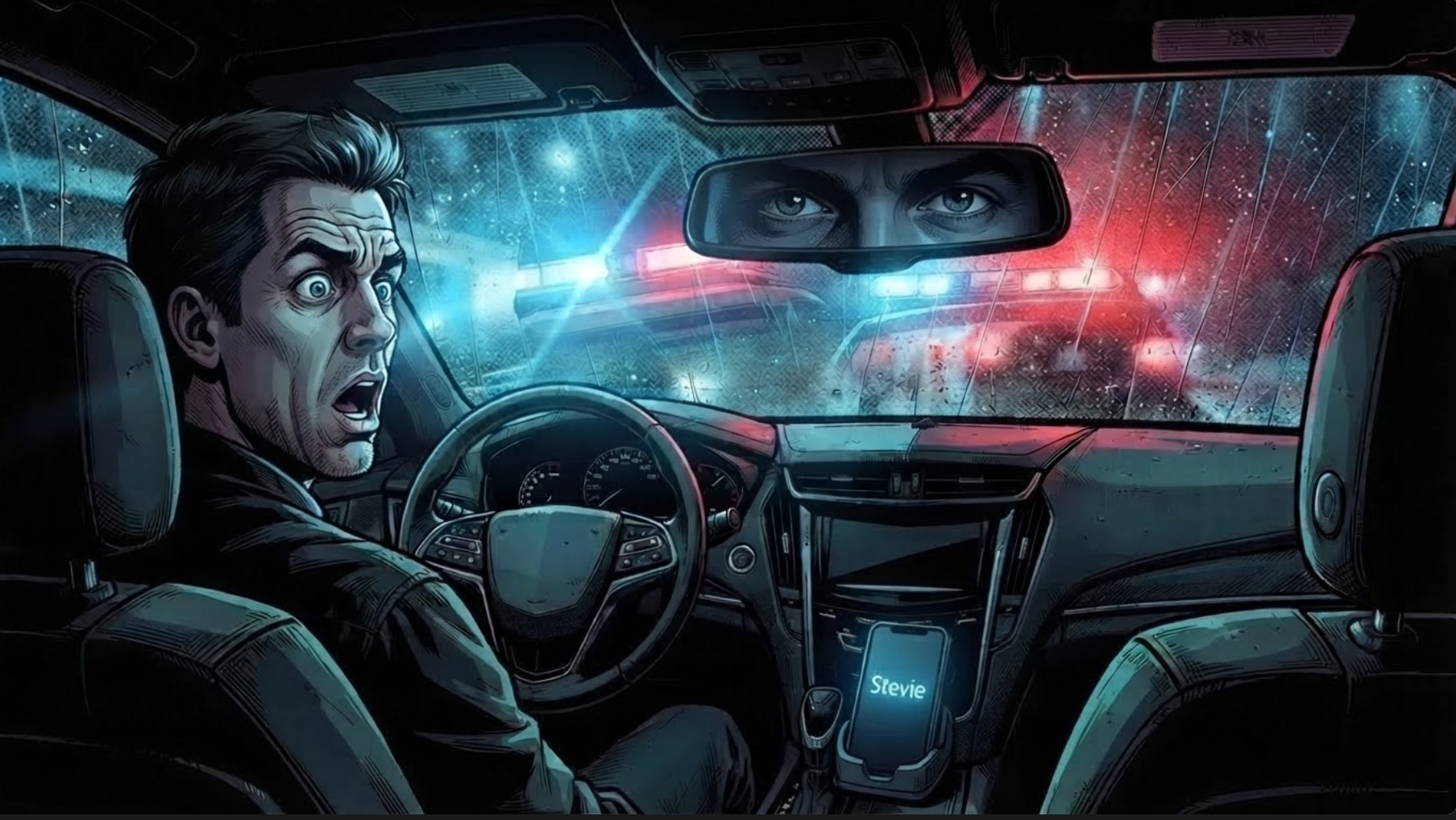
Stevie’s blood ran ice-cold as he looked back out his side mirror. The man pinned against the sedan in the blinding police spotlights wasn't Marcus. It was Pete, their old systems architect.
Stevie slowly turned his head toward the dark back seat of his Audi.
In the shadows of the rear-view mirror, a pair of eyes caught the flashing blue lights outside, and a cold metallic click echoed in the small, enclosed space.
"I took your voice twenty minutes ago," Marcus's true voice murmured from the dark. "Goodnight, Stevie."
POEM
Epilogue: The Phantom in Disguise
A Warning from Beyond: Vinnie’s Poetry Box
When the coroner cleared Vinnie’s home, tucked away inside a small wooden box on his desk—surrounded by old handwritten notebooks and Nortel memorabilia—they found a single folded index card.
Vinnie wasn't just tracking the digital footprints of a serial killer; he was trying to capture the eerie, deceptive reality of the world they lived in. This poem stands as a haunting, final testament—a direct warning to anyone who blindly trusts a screen, a phone number, or a familiar voice on the other end of the line:
I really enjoy our calls, you make things worth writing about.
One day, you'll discover that some people we doubt
Can hold a deep grudge for their failures, don't answer
To a voice on the line that you can't verify.
A name on a display is a dangerous shield,
In a world where trust is so easily healed.
Look past the caller, be guarded and wise,
Lest you open your door to a phantom in disguise.
— From Vinnie