
I never got the chance to go straight to university from school. Looking back now at 67—three years clear of prostate cancer, with a career in naval service behind me and an empty nest around me—I often wonder: If I had gone at eighteen, would my life have taken on a completely different vision?
To understand why so many of us in 1970s Britain took the long route, you have to look at the landscape of the time.
The 1970s Landscape: Tribes, Modernity, and the 11-Plus
I attended Evelyn’s School in the London Borough of Hillingdon between 1970 and 1975. Historically built as a Secondary Modern, Evelyn’s was caught in the middle of a massive educational experiment: the nationwide move toward comprehensive education. The 11-Plus, exam—a single test taken at age eleven—had already partitioned children into those destined for grammar schools and those sent to secondary moderns.
Failing the 11-Plus was a ghost that haunted many of us for decades. It handed you a label before you even understood who you were. Outside the school gates, 1970–1975 was a volatile era for Britain. The nation was grappling with the Three-Day Week, rolling power cuts, soaring inflation, and the looming economic anxiety of industrial decline. Globally, the Vietnam War was reaching its end, the Cold War shaped our horizons, and the UK’s entry into the European Economic Community in 1973 signalled a shifting world.
Within the school gates, that wider unrest filtered down into teenage life. You couldn't just be a student. You were forced to pick a tribe—defined by your music, your clothes, or whether you were on the sports team. If you showed a genuine hunger for books, you were semi-ostracised by the kids who made rebellion their full-time identity. Classrooms were often battlegrounds. New teachers were fair game for harassment, disruptions were constant, and discipline meant chalk dust, detention, or the cane. In that environment, admitting you actually wanted to learn meant stepping into the line of fire. So, like many, I kept my head down but still got caned for watching a fight outside of school!
From Jobs to Careers: The Scenic Route
Leaving Evelyn’s with few formal qualifications, the immediate options for a working-class lad were straightforward: factory work, manual labour, or finding another way out. I used to ask my own children as they grew up: “Do you want a job, or do you want a career?” Today, I watch out for my grandkids taking their first jobs—stepping stones on their own journeys, just as it started for my son and daughter before they carved out their careers. My stepdaughters both chose university, moved away from our now-quiet house, and are successfully living out the career visions they set for themselves.
For me, the Royal Navy offered a horizon far wider than the local industrial yards. Over the years, I worked my way up to Chief Petty Officer and qualified as a mechanical engineer. Yet even as I mastered blue-collar engineering and advanced through the ranks—where degrees were increasingly tied to officer promotions—that original hunger for broader learning never died. It had simply taken the long route. By my late twenties, I enrolled in the Open University to study the Humanities—history, literature, and music. For the first time, I wasn't studying to pass an 11-Plus hurdle or to fulfil a military requirement. I was studying purely for the love of the craft.
When those heavy OU course packs used to land on the hall mat with a thud, I thought studying was about conquering books. Decades later—after a life in uniform, raising a family, and facing a sharp reminder of mortality—I realise those books were simply holding up a mirror.
Property Realities: Then vs. Now
I read this week about some younger Gen Z-ers who think our generation had it easy, joking that you could buy a three-bedroom house for a tenner back in the day. It made me smile, but it also made me look back. My first home was a bungalow on Trenethick Avenue in Helston, Cornwall—it cost me £24,500 back then. Today, properties along that same road fetch roughly ten to twelve times that amount.
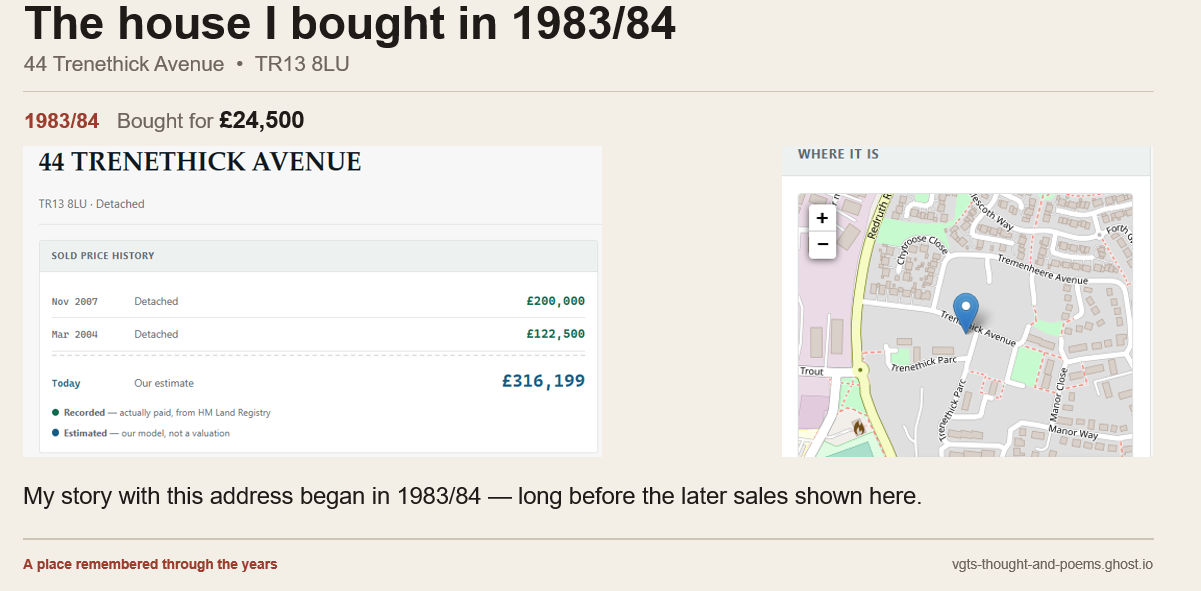
While we had to battle eye-watering interest rates that would make a modern mortgage holder faint, the math for young people today is undeniably harder. Back then, a home was roughly three to four times a worker's annual wage; today it is eight or nine. The young couples working all hours today aren't just trying to pay a mortgage—they are trying to leap over a massive deposit wall while paying high rent and planning for nursery fees, not mention the expensive solicitor and conveyancing fees and the latest tax increase - Stamp Duty! Just to say, we didn't get houses for a tenner, but the climb for the next generation to put down roots and start a family is undeniably steeper.
How Generations Cross the Threshold
I was born in the 1960s and raised in the tail end of post-war austerity. By the 1970s, the cultural rulebook was all about stiff upper lips, breadwinning, and quiet stoicism, before we eventually came of age in the loud, brash era of '90s "lad culture." Looking back, I’d like to think my generation has moved on in how we approach life's visions. We’ve had to adapt as parents, rethink how we handle what used to be brushed off as "banter," and navigate today's conversations around awareness and culture. But while we've grown, there are still plenty of massive changes waiting around the corner for the next generation to solve.
The path from secondary school to adulthood has shifted with every generation:
• The Boomers (My Era): Shaped by the 11-Plus, heavy industrial trade, and rigid social tribes. University was a rare privilege reserved for a small percentage of school leavers; for the rest, life meant early employment or military service, with higher education coming later as a deliberate second chance.
• Generation X (1980s–1990s): Saw the collapse of traditional manufacturing, the rise of the digital age, and the expansion of polytechnics into universities. They faced rising youth unemployment, but also the first major boom in accessible higher education.
• Millennials (Late 1990s–2010s): The first generation told that university was an absolute requirement. They gained widespread access to degrees but took on formal student debt and entered an economy reshaped by the 2008 financial crash.
• Generation Z (Today): I expect from my reading that students today—wherever they study in the world—sit in modern lecture halls surrounded by a hyper-connected digital roar. They face steep economic hurdles, just as I did, alongside high housing costs and intense competition just to hold their ground.
Yet Gen Z has developed something remarkable: emotional intelligence and self-awareness. Today’s young people are far better at protecting their mental health, embracing their true interests, and creating inclusive communities without having to hide a love of learning behind a 1970s denim jacket or a sports badge.
Books as Time Machines: A Late Life Calling
Now, sitting in the quiet of an empty nest, I realise there is a third choice that arrives later in life: a calling to simply learn for the joy of it.
Whether it’s picking up a classic you were too busy to read at thirty or re-reading a book with sixty-seven years of life experience behind your eyes, it is never too late to open the cover. Reading changes when you’ve lived. You read Homer’s The Odyssey not as an academic exercise, but as the story of an ex-serviceman trying to navigate the long way home. You read Hemingway’s The Old Man and the Sea or Kazuo Ishiguro’s The Remains of the Day and recognise the quiet dignity of service, duty, and resilience. You read Charles Dickens’ Great Expectations and laugh at how little human nature, social tribes, and posturing have changed since the 1800s.
What I’ve learned at 67 is simple: a vision for your life is never fixed at eighteen.
We sat in quiet rooms with high-street paperbacks; today's students sit under digital screens. But when the screen turns off and the page settles, the question remains identical for both the 20-year-old scholar and the 67-year-old veteran: What does it mean to live well?
What I’m Reading Right Now
My bedside table and headphones stay pretty busy these days. I like to keep a few different things on the go depending on what I’m doing:
• In print: Ben Macintyre’s Redwood — A gripping true Cold War espionage thriller following a defected KGB agent carrying a dangerous secret during the 1981 Iranian Revolution, and the MI6 handler working to stop a quiet nuclear crisis. Proper page-turning history that keeps you up past lights-out.
• On my headphones (for exercise): Wilbur Smith’s When the Lion Feeds — This is what keeps my legs moving when I'm out getting my daily exercise! It’s proper old-school adventure set in 1870s South Africa—following twin brothers through war, cattle raids, and the gold rush. Full-blooded storytelling with big landscapes that keep your mind off the miles.
• For pure excitement: Lee Child's Jack Reacher series — Whenever I just want a bit of straightforward adrenaline, I pick up a Reacher book. Being an old serviceman myself, there’s something wonderfully satisfying about an ex-military cop wandering the backroads of America, packing no luggage, taking no nonsense, and setting things right with sharp military logic and a heavy right hook.
Looking for New Horizons...
Lately, I've been tempted to step outside my usual comfort zone and try something brand new:
• Immersive Fantasy (Sarah J. Maas — e.g., A Court of Thorns and Roses or Crescent City): Epic world-building full of magic, ancient fae realms, political intrigue, high romantic stakes, and fierce battles.
• High-Octane Fantasy/Sci-Fi (Rebecca Yarros — e.g., Fourth Wing): Set in a brutal military war college for dragon riders, where cadets undergo lethal physical tests and battle for survival—think military discipline meets high fantasy with dragons!
• Or maybe just a cracking Comedy... Something like P.G. Wodehouse’s Jeeves and Wooster (for brilliant, light-hearted British wit) or Jonas Jonasson’s The Unlikely Pilgrimage of Harold Fry / The Hundred-Year-Old Man Who Climbed Out the Window (for a warm, absurd laugh at getting older).
POEM
The Long Lecture
We picked our music, chose our clothes,
And walked the schoolyard lines we chose.
Loving a book was dangerous ground
Coz, louder voices set the sound.
I found my classroom later on,
When Evelyn’s easy noise had gone—
In uniform, through Northern Lights,
Through hospital wards and restless nights.
A degree earned late still reads the same,
It opens doors, it plays no game.
Life’s visions change, but in the end,
Just have a read and find your friend.
Over to You
I’d love to hear your thoughts in the comments below:
For those who remember the 60s and 70s: What was the social scene like when you left school? Did you take a job, a career, or the scenic route?
For the younger readers & students: How does the pressure to choose a path feel today compared to what you’ve read here? Have I described anything that has inspired you to tell me about your aspirations or how you feel about studying?
To everyone: What are you currently reading, and if I dip my toe into fantasy, modern science fiction, or comedy next—which one should I start with?
Remember - Any Feedback or Comments - to tvincent481@gmail.com